
When does the woodland kingfisher arrive in the Greater Kruger?
Usually around mid-November, after the first rains. Our favourite summer bird, how to recognise its call, and the other migrants that arrive with it.

Usually around the middle of November, give or take a week or so, once the first proper rains have fallen. The woodland kingfisher spends the southern winter further north in Africa and comes south to breed in our summer. It stays until roughly March, then leaves as quietly as it arrived. For a few months it's the sound of the Lowveld.
I'll be honest: it's my favourite summer bird. Plenty of people here feel the same. Rangers have been known to place bets on the date of the first call, and once it starts, summer has properly begun.
- Woodland kingfishers arrive around mid-November and leave around March.
- You'll almost always hear one before you see it.
- They hardly ever fish, despite the name.
- Summer brings plenty of other migrants too, from the northern hemisphere and from elsewhere in Africa.
What does a woodland kingfisher sound like?
Loud, and very hard to ignore. The call starts with a sharp single note and runs straight into a long, descending trill, a bit like a referee's whistle with a stutter. They call from first light, often from a dead branch at the top of a tree, and they keep at it all day.
Watch one calling and you'll see the other half of the show. The bird spreads its wings wide while it trills, flashing the blue underneath, and sometimes swivels on the branch as if it wants to make sure everyone has noticed. Pairs often do it together.
How do you recognise one?
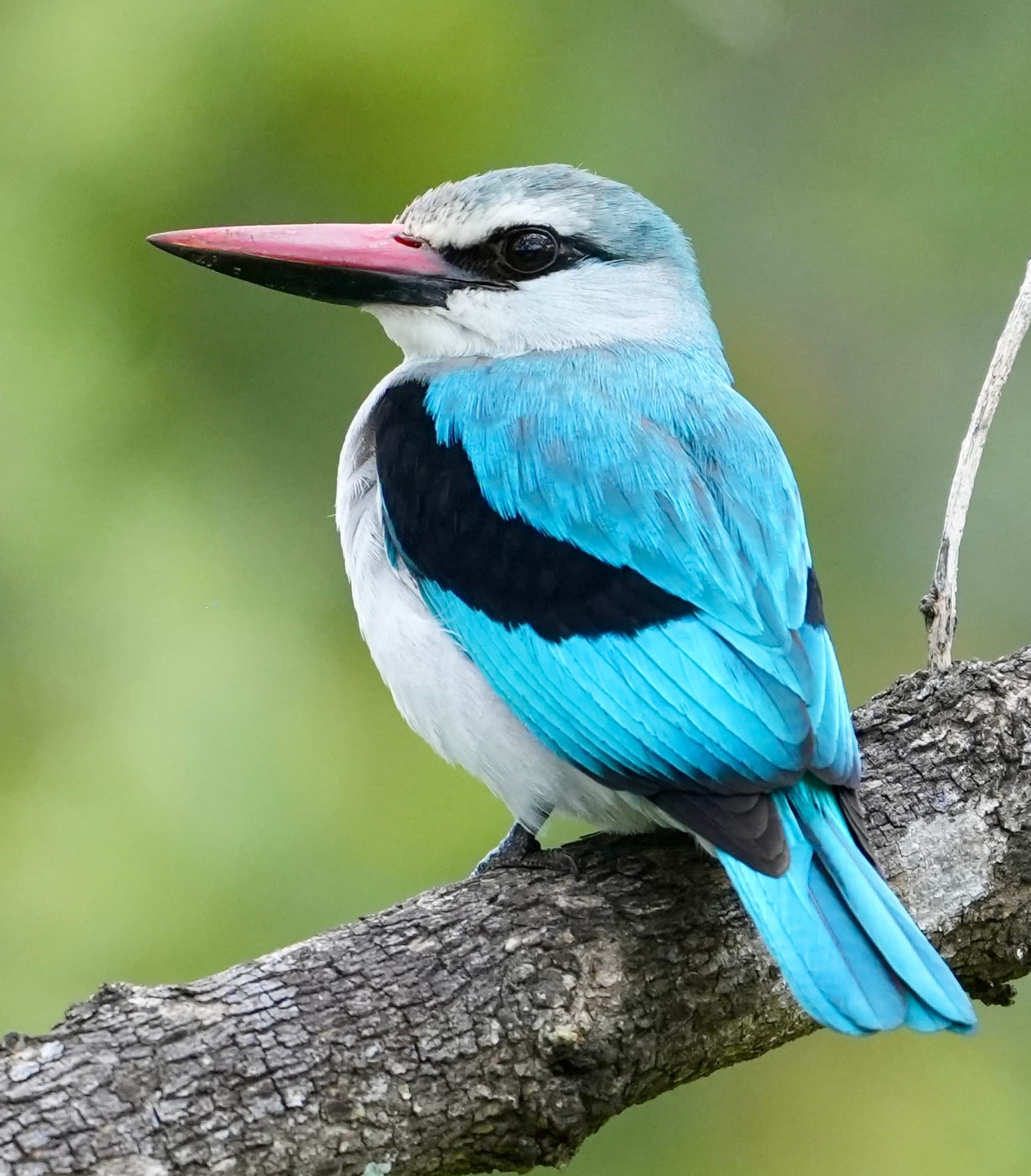
Look for bright turquoise blue on the back, wings and tail, a pale head and front, a black stripe through the eye and a black patch on the shoulders. The bill is the giveaway: red on top and black underneath. It's a medium-sized kingfisher, and in good light it looks almost too bright to be real.
The surprise for most guests is where you find them. Woodland kingfishers don't need rivers. They live in open woodland and bush, catching mostly insects, and the odd small lizard, from a perch. You're as likely to see one beside a lodge deck as anywhere near water.
Why do they come here for summer?
To breed. Summer rain brings a flood of insects, and that's exactly what a pair needs to raise chicks. Woodland kingfishers don't dig their own nests. They move into tree holes made by other birds, usually barbets or woodpeckers, and they'll defend them fiercely. They have been known to dive at anything that comes too close, people included.
By late summer the chicks have fledged and the calling eases off. Around March the birds head north again. The bush feels oddly quiet for a few days after they've gone.
Which other migrant birds arrive in summer?
The woodland kingfisher is the loudest of a big seasonal crowd. Some come from elsewhere in Africa. Others fly in from Europe and Asia to escape the northern winter. A few worth looking out for:
The European roller is a flash of lilac and blue, usually sitting on a bare branch or a fence post. European bee-eaters arrive in noisy flocks and hunt over open ground. The red-chested cuckoo announces itself with a three-note call that people here know by its Afrikaans name, Piet-my-vrou. And Amur falcons, small grey falcons that often gather on power lines, fly all the way from northeast Asia, crossing the Indian Ocean non-stop on the way.
For birders, this is why summer is worth the heat. The bush is thicker and the bigger animals take a little more finding, but the variety of birds goes up enormously. If you're curious how the animals handle the hottest days, we wrote about what animals do when Kruger hits 41°C.
When is the best time to come for summer birds?
From late November to February, if birds are a big part of the trip. The migrants are settled, calling and breeding, and the bush is at its greenest. It's also hot and can be wet, with afternoon storms, so it suits people who don't mind a sweaty afternoon in exchange for a lot of birdsong. Our guide to the Greater Kruger in summer sets out what that looks like day to day.
If you'd like a guide who really knows their birds, tell us early. Some guides are fanatics, and putting a birder with the right guide makes a huge difference. We'll be honest about which lodges have the strongest birding guides, but only from lodges we have stayed at or worked with closely.
Planner's note: Bring a small pair of binoculars, one for each person if you can. Sharing one pair on a vehicle is where friendships go to die, and summer birds don't wait.
Questions we are asked
When do woodland kingfishers arrive in Kruger?
Usually around mid-November, after the first good rains, though the exact date shifts a little each year. They stay until roughly March.
Where do woodland kingfishers go in winter?
They move north to other parts of Africa for the southern winter and come back to breed in our summer.
Do woodland kingfishers eat fish?
Rarely. They mostly eat insects, and the odd small lizard, caught from a perch in open woodland.
Is summer a good time for birding in the Greater Kruger?
Yes. Migrants from the northern hemisphere and from other parts of Africa arrive in summer, so the variety of birds is much higher than in winter.
What birding kit should I bring on safari?
A pair of binoculars each is the most useful thing. A field guide or a bird app helps, and your guide will usually carry a good reference book too.
Vikki Jackson is co-founder of Marula Hill Travel. We plan boutique safaris across South Africa, Botswana, Zambia, Zimbabwe, Kenya, Tanzania, Rwanda, Uganda, Namibia, and Mozambique. We have stayed in most of the lodges we recommend, and we tell you when we have not.
If this resonated
The bush has been expecting you
Start with a conversation. We will ask what makes you want to wake up at four-thirty, and build from there.
Begin a conversation
What do animals do when Kruger hits 41°C?
Mostly, they do less. How the animals of the Greater Kruger handle a heatwave, and what it means for your game drives.

Can you keep halal on safari in South Africa?
Yes, with planning. How halal works at South African safari lodges, from certified meat to prayer times on game drives.

Madikwe or Kruger? Emery Hassall explains
Madikwe isn't a smaller Kruger. Emery Hassall of Madikwe Safari Lodge explains why it works best alongside one.

Amarula fudge: a taste of the Lowveld to make at home
Four ingredients, one heavy pot and a bit of patience. Here's the fudge, and the tree behind it.

Serondella Safari Lodge: our review
Four suites beside a Thornybush waterhole that rarely sits still. We have stayed twice, and it keeps earning its place on our shortlist.

Christmas on safari in South Africa: is it too late to book?
Christmas in the bush is hot and green, with baby animals everywhere. Here is what the festive season is really like, and how to find space at this stage.

Michelin Keys on safari: what they tell you, and what they don't
A Michelin Key tells you a lodge is a remarkable place to stay. It can't tell you how good the safari will be. Here is how to use one.

BA's new Tanzania flights: how to build a safari and Zanzibar trip that flows
Fly into the safari, fly home from the beach. How to use BA's new Tanzania route without spending half your holiday in transit.

How to read a safari quote: what all-inclusive really covers
Two quotes for the same week can sit a long way apart and both be honest. Here is what each line covers, what all-inclusive really means, and where the differences hide.

Safari specialist or big operator: who should plan your safari?
A fair look at when a large safari operator is the better call, when a small specialist is, when to book direct, and what to ask any of them before you pay.

Kruger park fees are going up: what it means for your safari quote
New Kruger fees start on 1 November. Here is who actually pays them, and why most Greater Kruger guests pay a reserve levy instead.

Greater Kruger in summer: is a hot, dry season still worth it?
A hotter, drier summer is on the cards. Here is what that means for your days in the bush, from people who live here.

Gay travel in South Africa: an honest safari and city guide
Cape Town, Johannesburg and the bush: an honest guide for gay and lesbian couples planning South Africa.

Where the herds are: the Great Migration month by month
The migration moves all year. Here is where the herds tend to be in each season, and how we plan a trip around them.

Walking safari: why you see Africa differently on foot
You cover less ground on foot, and somehow you see much more.

Planning your first safari? Start with the people who can hear the hyenas
What we would tell you about your first safari if you sat down at our kitchen table. There is usually gin.

What we would tell a young woman starting out in safari travel
Both of us came out of corporate, one of us with travel experience already. This is the advice we give when a young woman writes and asks how to build a career in luxury safari travel.

Is a safari safe for gay and lesbian couples?
An honest, country-by-country answer for same-sex couples planning a safari.

Botswana has water again. Here is what that means for your safari.
Botswana is having a stronger water year. Here is what that changes, and why the right lodge and the right week still matter more than a brochure month.

18 On The Hill: our stay at a tented lodge in the Greater Kruger
We stayed at 18 On The Hill, a luxury tented lodge in the Greater Kruger. The food, the suites, a kosher kitchen and drives that never felt the same twice.

Royal Malewane reopens: what we remember, and what the fact sheet confirms
The original Royal Portfolio property is back after months behind scaffolding. We haven't seen it yet. Here is what we know anyway.

We run on solar and we have not printed since 2019
Vikki and Sian on solar power, paper, and what a small safari company can honestly claim.

Sandringham Private Game Reserve: should you go early, or wait?
Greater Kruger's newest reserve opens in August 2026. Our honest take on who should book Sandringham early, and who should give it a few seasons.

How do you want to feel when you get home?
Why we plan safaris around how you want to feel when you get home, not around a pin on the map.

South Africa's online traveller declaration: what it means for your safari (and what it doesn't)
A five-minute customs form now stands between you and the arrivals hall. Here's what it is, who needs it, and what nothing to declare actually means for a normal safari guest.
